Member Content

Regional carriers are operating in one of the most demanding environments the industry has faced in years. There has been never-ending pressure to modernize networks, improve customer trust, reduce fraud, strengthen security, support new service models, and maintain resiliency, all while managing limited staff, tighter budgets, and an increasingly complex partner ecosystem.
The carriers stacked point products for security, performance monitoring, fault management, configuration control, and service assurance. The solutions were reliable, from credible vendors and each of the dashboards delivered on what it promised.
Then the collection of point products failed to deliver what matters most: consistent operational control.
This is not a story of bad decisions. It’s a story about the cascading cost of good decisions. Every tool in the stack was bought to reduce a specific risk. But the strategy of adopting best-of-breed solutions didn’t account for a day the collective pieces stopped strengthening operational control and instead turned resilience into vulnerability.
That is why the industry needs a shift in mindset. The next phase of progress will not come from adding more disconnected point solutions, including more dashboards. It will come from simplifying operations and creating a stronger foundation for operational control. Carriers need a practical way to manage networks and services with enough visibility, automation, and intelligence to regain and sustain operational control supporting trusted communications, reduce exposure to outages, and strengthen day-to-day operational execution. And most importantly, the next phase is not to abandon what was built. The next phase is a layer that unifies the tools already in place.
Security, trust, and resiliency are often discussed as separate priorities, but in practice they are deeply connected by a common dependency on operational control. Trust breaks down when fraud reaches subscribers. Resiliency weakens when operations teams cannot identify service-impacting issues quickly. Security programs become harder to sustain when visibility is fragmented across too many tools, dashboards, and manual processes. In regional carrier environments, these challenges rarely appear one at a time. They arrive together.
This is where many operators are feeling the greatest strain. Branded calling, branded messaging, authentication services, identity verification, fraud prevention, and API-based services all offer promise. But each new initiative can also introduce another layer of operational dependency. When these efforts are supported by siloed tools and disconnected workflows, the result is often higher cost, slower response times, and more complexity for already stretched engineering and operations teams.
In that kind of environment, trust is not built only through customer-facing features. Trust is also built through consistent execution behind the scenes. It depends on whether operators can maintain service continuity, detect performance issues early, correlate events across the network and service stack, and respond before minor faults become customer-visible problems. Trust is strengthened when carriers can show reliability, not just promise it.
Resiliency works the same way. It is not simply a recovery plan or a compliance checkbox. It is the operational capability to see what is happening across the environment, understand what matters, and act fast enough to protect revenue, customer experience, and brand credibility. For regional operators in particular, resiliency must also be cost effective. It has to reduce manual effort, eliminate unnecessary tool overlap, and help lean teams do more with confidence.
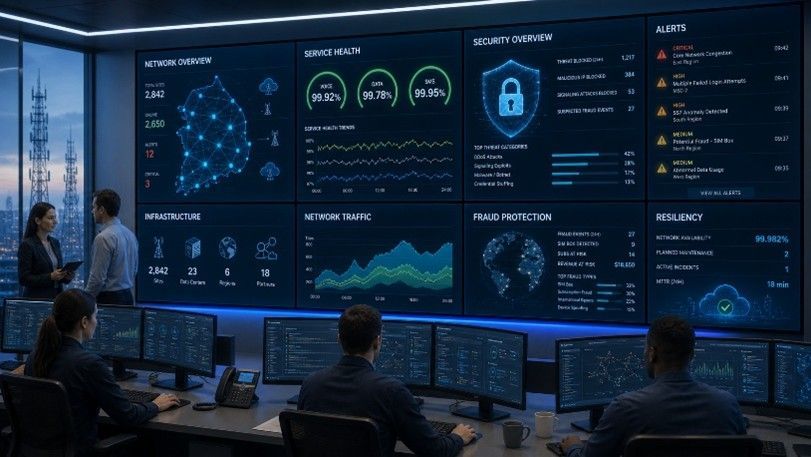
This is exactly why a platform strategy matters. Infosim© ’s StableNet© is designed for carriers and service providers that need to unify operations rather than add to the clutter. StableNet© gives operators a centralized way to monitor, manage, and automate complex network and service environments. Instead of forcing teams to work across multiple disconnected systems, StableNet© helps create a consolidated operational view that becomes the control panel for fault management, service visibility, automation, and faster incident response.
For CCA members, the opportunity is not simply to keep up with the market. It is to shape a stronger operating model for the future. Security, trust, and resiliency should not be treated as isolated projects. They should be built into the way the carrier operates every day. That requires a move away from complexity and toward platforms that make action easier, faster, and more cost effective.
For CCA members interested in discussing an on-prem or SNaaS (StableNet as a Solution) model and how this approach can support their own operational priorities, Larry Leal (leal@infosim.net) of Infosim© is available to provide more information.

To contribute content, please contact comms@ccamobile.org. (CCA members only.)