Member Content
From Intent to Safe Autonomous Execution: A Framework for AI-Driven Network Management
By: Praven Reddy, Head of Sales - North America
Digitata Networks
Introduction
AI is moving from experimentation to operational reality in telecommunications. Industry standards bodies such as 3GPP are already incorporating AI and machine learning into the radio access network to improve areas such as traffic prediction, mobility management, link adaptation, and positioning accuracy. In practical terms, this means AI is becoming part of how future networks are designed, optimized, and operated.
Looking ahead, AI is expected to be a foundational capability in 6G-era networks. The IMT-2030 vision highlights areas such as non-terrestrial connectivity and integrated sensing and communication, both of which introduce greater operational complexity and require faster, more adaptive decision-making. AI will be essential for managing that complexity at scale and in real time.
This shift is also visible in AI-RAN, which brings AI and network operations closer together in three ways: using AI to improve RAN performance, running AI workloads on RAN infrastructure, and embedding AI more deeply into network control functions. The strategic implication is straightforward: networks are evolving from systems that are manually configured to systems that can continuously assess conditions, recommend actions, and increasingly act with automation.
For executives, the key question is no longer whether AI will influence network operations, but how to adopt it in a way that is controlled, accountable, and scalable. The framework below outlines a practical model for turning business and operational intent into safe, governed autonomous execution.
A Complete Agentic System
An AI agentic system can be understood as seven sequential steps, providing leaders with a concise reference model for how intent becomes governed execution in an intelligent automation environment.
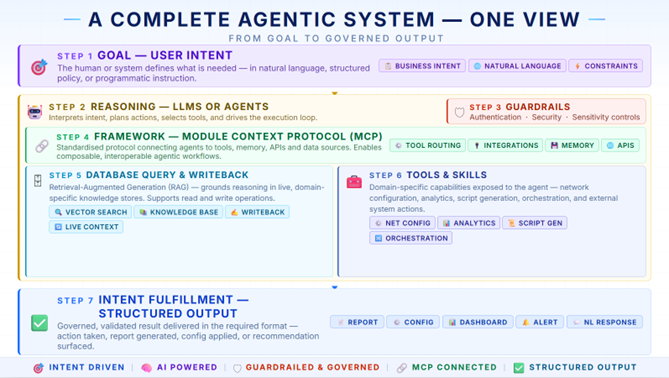
Figure 1: A complete Agentic system - One view, highlighting the steps from goal to governed output
The flow begins with Step 1: Goal — User Intent, where a human operator or upstream system articulates what is needed, whether in natural language, structured policy, or programmatic instruction. This intent-first paradigm is central to modern AI deployment: rather than specifying how a task should be executed, the operator expresses what outcome is required.
Step 2 hands that intent to Reasoning — LLMs or Agents, which interpret the request, decompose it into executable subtasks, select appropriate tools, and drive the subsequent execution loop.
Operating concurrently, Step 3: Guardrails enforces authentication, security controls, and sensitivity boundaries to ensure that the reasoning layer cannot act beyond its authorized scope.
Step 4 introduces the Framework — Model Context Protocol (MCP), a standardized connectivity layer that links agents to memory stores, APIs, and external tools in a composable, interoperable manner.
Steps 5 and 6 extend this connectivity: Database Query & Writeback grounds the agent in live, domain-specific knowledge through retrieval-augmented generation (RAG), while Tools & Skills expose domain capabilities such as network configuration, analytics, script generation and orchestration.
The cycle concludes at Step 7: Intent Fulfillment — Structured Output, delivering a governed, validated result in the required format, be it a configuration change, report, dashboard update, or alert.
Building beyond this, a continuous loop helps define being truly Agentic and Autonomous from Intent. As we make the change in the network, we observe the impact of the change managed autonomously.
Unified Layered Architecture
The path from goal to governed output can be operationalized as a seven-layer enterprise architecture. Together, these layers show how intent is converted into controlled action through agentic AI, platform governance, orchestration, contextual awareness, and safe execution. [Tools in Digitata Network portfolio are referenced as illustrative examples in this framework.]
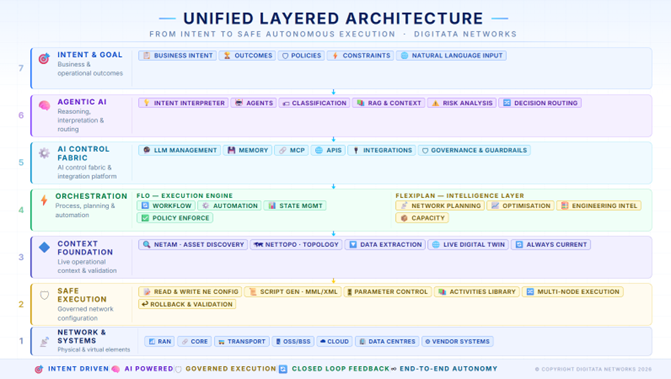
Figure 2: Unified Layered Architecture, from Intent to Safe Autonomous Execution
Layer 7: Intent and Goal — accepts business outcomes, operational policies, and constraints expressed in natural language.
Layer 6: Agentic AI — performs intent interpretation, risk analysis, classification, and decision routing, forming the cognitive core of the system [e.g., AiDN].
Layer 5: AI Control Fabric — provides platform infrastructure: LLM lifecycle management, memory, MCP connectivity, API integrations, model routing, and governance guardrails [e.g., AiDN Studio].
Layer 4: Orchestration — divides responsibility between workflow and automation execution engine (e.g., FLO) and the intelligence layer that handles network planning, capacity management, and engineering optimization [e.g., FlexiPlan].
Layer 3: Context Foundation — maintains the live digital twin of the network through asset discovery and inventory [e.g., NetAM], topology mapping [e.g., NetTOPO], and continuous data extraction. The “always-current” operational context is the factual anchor for all AI reasoning.
Layer 2: Safe Execution — translates approved actions into network element configurations via MML and XML script generation, parameter control, multi-node execution, and rollback with validation [e.g., NetCM].
Layer 1: Network and Systems — represents the physical and virtual substrate: RAN, core, transport, OSS/BSS, cloud, data centers, and vendor systems.
For leadership, the significance of this architecture is clear: it creates a governed path from strategic intent to operational execution, with closed-loop feedback supporting scale, resilience, and increasing autonomy.
Safe Execution Model
For executive stakeholders, the most important design consideration in autonomous network management is the governance boundary between AI reasoning and network execution.
Intent must move through the Interpreter and Mediation Layer to the anchor products and, finally, to the network, with a deliberate and prominently marked "strong barrier" separating the anchor products from the network.
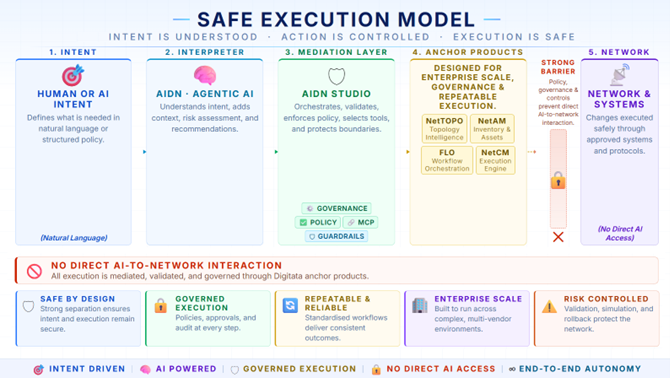
Figure 3: Safe Execution Model where Intent in understood, Action is controlled and Execution is safe
The following principle is made explicit: No Direct AI-to-Network Interaction is allowed ensuring that every action is governed, traceable, and insulated from direct AI-to-network interaction.
Five foundational pillars underpin this safe execution model: Safe by Design, Governed Execution, Repeatable and Reliable, Enterprise Scale, and Risk Controlled, with the last incorporating validation, simulation, and rollback to protect the network at every stage of change.
Summary
Taken together, this framework offers leaders a practical model for scaling AI-driven network automation with control and confidence. The agentic system defines how intent is interpreted, the layered architecture shows how capabilities are operationalized, and the safe execution model ensures that autonomy remains governed, auditable, and trustworthy.
As 3GPP embeds AI more deeply into network functions and IMT-2030 expands intelligent connectivity into non-terrestrial domains and ISAC, operators will need frameworks that combine AI agility with enterprise-grade governance. The model presented here provides a credible path for moving from intent-based management to trusted, end-to-end network autonomy.
To contribute content, please contact comms@ccamobile.org. (CCA members only.)